
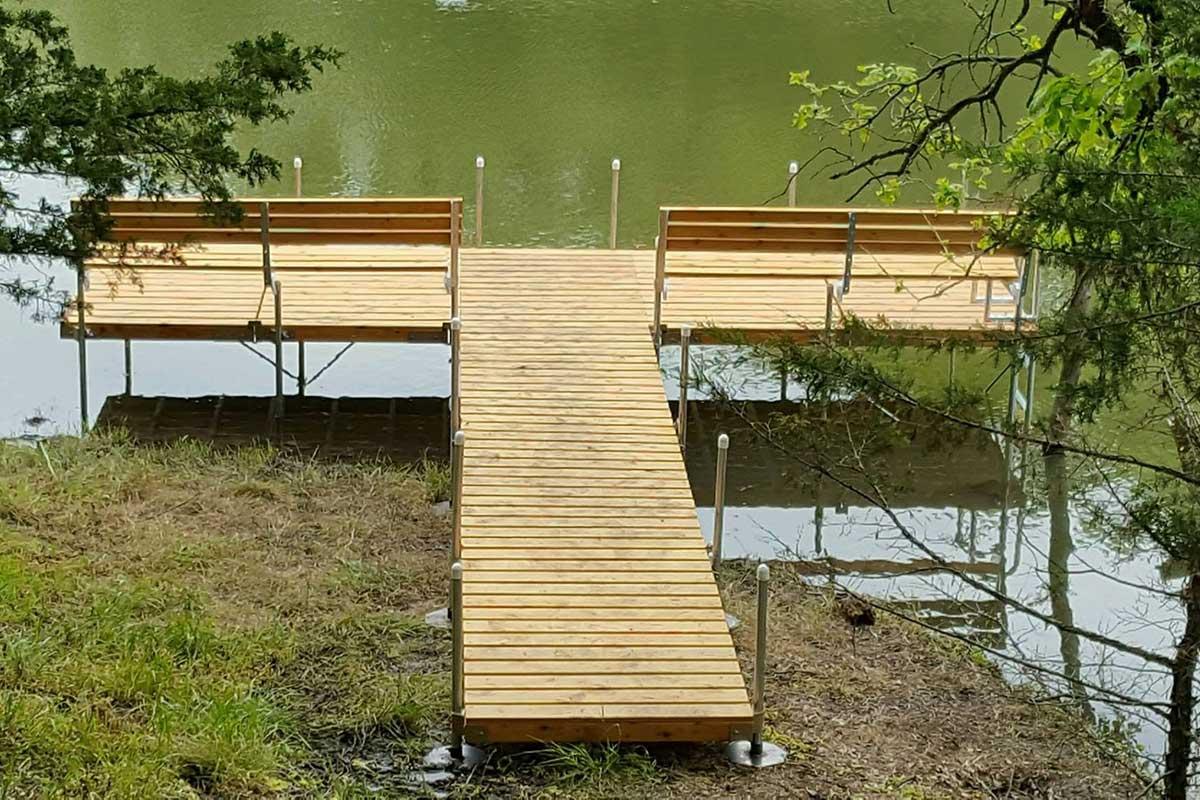
How Much Does a Boat Dock Cost? What Drives the Price
Residential boat docks run about $4,000 to $26,000 installed, and the national average sits close to $15,000, which Angi's 2026 figures put at $4,074 to $26,021. Per square foot, budget $15 to $40. Use those numbers as a starting point, not an answer, because four things move the price more than anything else: the dock type your shoreline can actually support, the size and layout you need, the material, and whether you put the dock in and take it out yourself each season or pay somebody to do it.
That last one is the number most owners leave out of the math. A dock one person can install and remove has no service bill attached to it, spring or fall. A dock that needs a crew, a barge, and a crane has one every season for as long as you own the place, and it only grows.
Key Takeaways
- National dock costs land near $15,000, but a seasonal dock in the upper Midwest usually shops in the lower half of that spread.
- Your lake bottom decides the dock type, and the dock type is the biggest cost lever you have.
- Cedar costs less up front and asks for more of your Saturdays. Aluminum costs more and asks for almost none.
- Yearly install and removal is a real cost, and it never shows up on the first quote.
- No dock is maintenance free. The cheapest dock to buy is rarely the cheapest one to own.
What does a boat dock cost on average?
The national numbers are worth knowing. They are also worth taking with a grain of salt.
Angi's 2026 figures put the typical build at $4,074 to $26,021, average near $15,048, with outliers from about $1,000 to $65,000. HomeAdvisor's 2026 data lands close, with most homeowners near $14,835 and a full range of $750 to $65,000. Most residential docks fall between 100 and 400 square feet. By type, floating docks run roughly $15 to $40 per square foot and $3,000 to $17,500 all in. Piling and pipe docks run about $20 to $40 per square foot. Crib docks built with rock-filled frames climb to $50 to $100 per square foot.
Here is what the averages hide. Those figures blend in permanent concrete and crib structures on southern reservoirs and saltwater piling docks on the coast. A seasonal dock on an Iowa lake, the kind that comes out of the water every fall, is not that. If you are pricing a sectional or floating dock for a lake home in the upper Midwest, you are usually shopping in the lower half of that spread, and your money is going into frame, hardware, and decking, not into pile driving.
We quote every dock rather than publish a price list. So the useful version is this: exactly what moves the number.
What actually drives the price?
Your lake bottom picks the dock type, not your budget
Get this one straight first. It is the biggest cost lever and the one you have the least say over.
A firm, shallow bottom with steady water suits a sectional dock, the kind that stands on legs and pipe set into the bed. A soft, silty, or deep bottom, or water that swings a foot or two through the season, calls for a floating dock that rides on the surface instead of standing on the bottom. A gradual slope over a firm or rocky bottom is roll-in territory. We walked the whole decision through in our guide to choosing the right dock for your lake and shoreline, and the soft-bottom case gets a closer look in the best dock for a soft, silty, or deep lake bottom.
People try to shop around this, and I have watched it happen. They price a sectional, see it under a floating system, and put post legs into muck anyway to save a few thousand. Then they spend every June re-leveling a dock that is slowly sinking, and they replace it years earlier than they should have. That is not a savings. That is a payment plan that never ends.
Size and layout
Docks price by the section and by the square foot, so length and shape drive the total in a straight line. Our standard sectional is 4 feet by 7 feet, with aluminum also in 4 by 10. A straight run out to your water depth is the cheapest configuration per foot. Add a Full Wing or Partial Wing in an L or a T, add a boat slip, add a marina layout, and you are adding sections, bracing, and hardware to each one.
Buy the dock you will use. I mean it. A wing you sit on every evening earns its keep. A wing that looks good from the water and holds two chairs nobody sits in costs real money up front, and it means carrying more sections up the bank every October.
Material
This is where the up-front price and the long-term price pull against each other, and it is the choice people regret most. Angi's 2026 data puts pressure-treated wood at $20 to $70 per square foot with high maintenance, aluminum at $25 to $75 with low maintenance, and composite at $90 to $175. Our own lines follow the same shape. The sectional Western Red Cedar dock has been our most economical line since 1959. The sectional aluminum dock, built from 6005-T5 aluminum with welded and gusseted corners, costs more to buy and asks almost nothing after that, no staining, no sealing, no replacing boards.
Think about the upkeep before you choose, because this is where it comes back to you. Cedar is a genuinely good dock wood, and it looks better than anything else on the lake. It is also wood. The Western Red Cedar Lumber Association is plain about it: every finish applied to cedar needs regular cleaning and renewal to keep performing, and a dock surface takes more sun and water than a deck ever will. If you enjoy that kind of Saturday, cedar is the better value. If you do not, you will let it go, and five years out you will be glad you did not. Aluminum buys those Saturdays back up front.
Site work, permits, and the rest around the dock
The dock is not the only line on the project, and I wish people would budget for the rest up front rather than discover it at the end.
Hauling off the old dock runs $250 to $1,000 for removal and disposal. Add a boat lift, which is a separate purchase and not a small one, lifts run $2,000 to $20,000 by type and capacity. Insurance often nudges up too, figure $50 to $300 a year and check how your carrier treats it.
Two things people forget. Permits. Docks, hoists, and buoys on Iowa public waters have to be permitted, and the Iowa DNR requires any fees owed to be paid in full before any part of the dock goes in. Fees and rules vary by lake and change, so confirm the current ones with the DNR. Our Iowa dock permit guide covers the basics for the Iowa Great Lakes. And accessories. Ladders, benches, railing, boat cushions, a stabilizer bar, each is its own line, and they are the things that make a dock pleasant to use. Price them in rather than promising yourself you will add them later, because you will not.
What does the dock cost after year one?
Routine maintenance runs $300 to $1,200 a year across the materials in the figures above, and repairs run $200 to $4,000 depending on what broke. Reasonable numbers to plan with.
The bigger one, up here, is seasonal service. Marine labor runs about $40 to $110 an hour, and around the Iowa Great Lakes a lot of dock work goes out by barge and crane, billed once to put the dock in and once to pull it. Two service calls a year, every year, is the line item that quietly outgrows the price difference between two docks. Run it out over the years you will own the place and it stops being a rounding error, fast.
So when you are comparing quotes, ask the second question along with the price one: what does this dock cost me every April and every October, not just this once?
Where does a one-person install save you money?
This is the part we have been working on the longest. In 1959 we were the first dock company to build a sectional Western Red Cedar dock that one person could install, remove, raise, and lower without getting in the water. We call it Walk On Water, and it is still the clearest thing that separates our sectionals from the rest of the market.
The mechanics are simple enough to see. Sections average about 80 pounds, which is a one-person lift. All the work happens above the water while you stand on the dock you are building. Each section folds down after the last one, using a winch system built for the job. A patented pipe casting and adjustable heavy-gauge steel anchor plates handle the leveling. There is a fuller walkthrough in our post on installing a dock by yourself with the Walk On Water system, and the fall version in how to remove a boat dock by yourself.
Two caveats, and I will not soften them. It is still a job. Plan on a morning, good footwear, and a helper the first time if you have never done it. And it applies to the sectional lines. Floating docks are heavier systems with anchoring to set, and professional installation is available for them for a reason.
Is the cheaper dock ever the better deal?
Sometimes. If you have a small budget, light use, and a short season, a modest dock that does one job well beats a system you had to stretch for. I would rather sell you the right small dock than the wrong big one.
But here is the thing. A dock sits in water, ice, and sun for a long time, and the failures that end one are almost never cosmetic. They are structural. Cracked brackets. Bent braces. Anchor plates worn oval at the adjustment holes. Welds that have opened. If you want to see what that looks like on your own dock, our post on the signs you need a new dock walks through the inspection.
Connections carry the load. That is why both of our sectional lines carry a lifetime warranty on the heavy-gauge steel brackets and our floating docks carry a Comprehensive Limited Warranty. It is a statement about where we put the money. It is not a promise that ice will never touch your dock, and I would not make that promise. No dock is damage proof and no dock is maintenance free, and anyone who tells you different has not pulled a neglected dock out in April.
Where VW Docks fits
We build the whole range in Spirit Lake, Iowa, which is the reason we have no stake in which one you pick. Sectional cedar, sectional aluminum, residential and commercial floating docks built to U.S. Army Corps of Engineers standards, accessible docks, roll-in docks, swim platforms. They all come out of the same shop, so we have no reason to push the one we stock. If your bottom is firm and shallow, we point you at a sectional and show you how to put it in yourself. If it is soft or deep, we point you at a floating system and tell you up front that installation is a bigger job. We sell through dealers across Iowa, Minnesota, and Wisconsin, and you can also come to us directly for a quote.
Frequently Asked Questions
How much does it cost to have a dock put in and taken out each year?
It depends on your lake, your access, and the dock itself. Marine labor runs roughly $40 to $110 an hour in 2026 industry figures, and crews using a barge and crane bill more than a two-person walk-in crew. Ask any service for a per-visit price before you buy the dock, not after, and remember you pay it twice a year for as long as you own it.
Is a floating dock cheaper than a sectional dock?
Not by itself. The national per-square-foot ranges for the two overlap almost completely, so the price is not the deciding factor. The site is. On a soft, silty, or deep bottom, or where the water level swings, a floating dock will usually cost less over the years even when the quote comes in higher, because it is not fighting the lake bed every season.
Do I need a permit, and does that add to the cost?
On Iowa public waters, docks, hoists, and buoys must be permitted by the Iowa DNR, and the DNR requires any fees owed to be paid in full before any part of the dock is installed. Permit classes, fees, and placement rules vary by lake and change over time, so check the current requirements with the DNR before you budget.
What makes a dock wear out faster than it should?
Three things, in our experience. Leaving it in through freeze-up and ice-out, which is what ice damage really is. Letting a wood surface go unfinished year after year until the boards are past saving. And putting the wrong dock type on the wrong lake bottom, which loads brackets and legs in ways they were not built for. Avoid those three and normal care handles the rest.
Why does VW Docks not publish prices?
Because the dock is configured to your site. Section count, layout, frame material, decking, and accessories all move the number, and floating frames are built to the application, so a price list would be wrong for almost everybody who read it. Tell us your shoreline and how you use the water and we will put a real number in front of you.
What to do next
If you are pulling your dock this fall and what you found has you thinking, price a replacement now rather than in April, when every lake owner in the Midwest wants theirs in the water the same week. Request a quote and tell us about your shoreline, or find a dealer near you in Iowa, Minnesota, or Wisconsin.
Share This Post
Comments
Read Our Other Blog Posts.
